
Frequently asked questions about driving on Austrian roads
Navigating Austrian highways, paying motorway tolls, and tackling alpine passes often raises practical questions for international motorists. Below are answers to frequent inquiries concerning speed limits, vignette compliance, winter equipment laws, tunnel passage fees, and cross-border driving procedures. VigneteRey provides these answers as an independent editorial guide to help you travel safely and lawfully across Austria.
Access comprehensive guidance before setting off across the Alps or entering electronic toll gantries.
Essential Operational Baselines
Official baseline values verified for the current driving season. Mandatory compliance applies on all federal corridors.
Comprehensive Navigation Inquiries
Every entry is researched from official Austrian federal transport legislation, ASFINAG operational mandates, and road safety protocols.
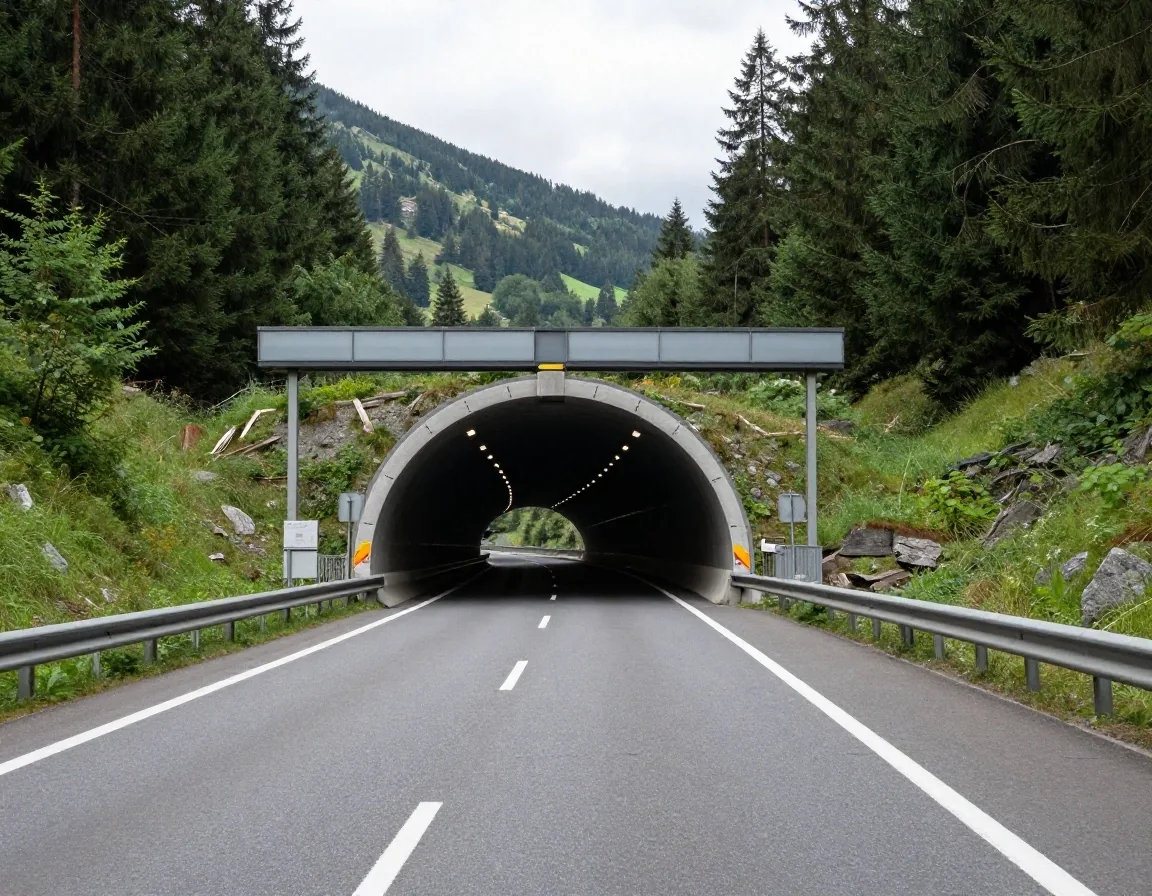
Explore step-by-step corridor profiles including gradient warnings, tunnel fees, and scenic detour options.
Launch route plannerSpeed limits on Austrian motorways and open roads
What are the standard speed limits for passenger cars across Austria?
In built-up municipal areas, the default speed limit is 50 km/h unless signs indicate 30 km/h or 40 km/h zones. Outside built-up areas on open regional roads (Bundesstraßen and Landesstraßen), the limit is 100 km/h. On motorways (Autobahnen), the default limit is 130 km/h, and on expressways (Schnellstraßen), it is 100 km/h or 130 km/h as posted.
Along certain environmentally sensitive corridors, variable matrix signs drop the limit to 100 km/h under the IG-L (Immissionsschutzgesetz-Luft) air quality framework. Fines for exceeding an IG-L speed limit are significantly higher because they constitute environmental infractions alongside traffic offenses.
How do variable message signs on the Inntal and Tauern corridors operate?
On arterial routes such as the A12 Inntal Autobahn and A10 Tauern Autobahn, overhead electronic gantries monitor air pollutants and traffic density in real time. When pollutant thresholds are crossed, illuminated circles display "100" accompanied by the textual tag "IG-L".
Fully electric vehicles registered with green license plates are granted exemptions on designated IG-L stretches in accordance with Austrian federal regulations, but international motorists driving pure EVs must ensure their vehicle registration documents clearly prove zero emissions if challenged.
Vignette purchase requirements and placement
How and where must I display a physical vignette on my vehicle?
A physical adhesive vignette must be firmly affixed to the inside of the front windshield before entering an Austrian Autobahn or Schnellstraße. The approved positions are behind the rear-view mirror or on the upper left edge of the glass. It must not be attached to the tinted sun-strip or side windows.
Alternatively, you can purchase a digital vignette linked to your vehicle license plate, eliminating the need for a physical sticker entirely. Overhead optical camera enforcement systems automatically check number plates against the federal database without requiring you to stop.
Can I buy a digital vignette online and use it immediately?
Yes, for one-day and ten-day digital vignettes, immediate online activation is now legally permitted for consumers. These short-duration passes can be bought minutes before your journey and are valid straight away upon checkout completion.
However, for two-month and annual digital vignettes purchased online by private consumers, European consumer protection regulations generally impose an eighteen-day waiting period before the vignette becomes active, unless registered under commercial business status. Always confirm the validity start date stated on your purchase receipt before driving onto a toll road.
Distinguishing vignettes from section tolls (Streckenmaut)
Does my Austrian highway vignette cover the Brenner Pass and Tauern Tunnel?
No. Major alpine tunnels and passes, including the A13 Brenner Autobahn, the A10 Tauern and Katschberg tunnels, the A9 Bosruck and Gleinalm tunnels, the A11 Karawanken Tunnel, and the S16 Arlberg Road Tunnel, are designated as special toll sections (Streckenmaut).
These sections require separate passage tolls paid online or at roadside toll plazas, regardless of whether you possess a valid standard vignette. Conversely, on certain sections like the A13 from Innsbruck to the Italian border, you do not need a standard vignette at all if you are only driving on that specific Streckenmaut corridor.
How do digital section toll lanes (green marked lanes) work at toll plazas?
If you pre-pay your single or multi-trip Streckenmaut ticket online, you can use the designated green-marked lanes on approach to the barrier station. Optical scanners read your vehicle license plate as you roll forward at low speed.
When valid prepaid clearance is detected, the barrier opens automatically, allowing you to pass through without opening windows or presenting paper tickets. Ensure your license plate is kept clean of mud or snow to prevent scanner read delays.
Winter tire regulations and snow chain rules
When are winter tires legally required in Austria, and what tread depth is mandatory?
Between November 1 and April 15, winter tires are legally required on all passenger cars whenever winter road conditions (snow, slush, or ice) exist. Tires must carry M+S or 3PMSF markings with a minimum tread depth of four millimeters for radial tires and five millimeters for diagonal tires.
Operating summer tires on winter roads during this period carries heavy fines and can void collision insurance coverage in the event of an accident. If conditions deteriorate unexpectedly, all four wheels must have conforming tires.
Am I legally required to carry snow chains in my car at all times during winter?
There is no blanket federal requirement to carry snow chains on all Austrian roads for passenger vehicles. However, when driving into alpine valleys and over mountain passes marked with circular blue snow chain signs, mounting chains on drive wheels is legally mandatory.
Drivers visiting ski resorts or high-altitude passes in winter should carry matching snow chains in their trunk to avoid being turned back at police checkpoints. Chains may only be fitted when roads are covered with a continuous layer of packed snow or ice, preventing damage to the road surface.
Emergency corridors (Rettungsgasse) and border crossing rules
How do I correctly form the Rettungsgasse in a traffic jam?
As soon as traffic begins to slow on an Autobahn or Schnellstraße, you must prepare the emergency corridor before stopping. On a two-lane road, vehicles in the left lane steer as far left as possible, while vehicles in the right lane steer as far right as possible, utilizing the emergency shoulder if needed.
On three-lane roads, vehicles in the far left lane pull left, while vehicles in the center and right lanes pull right, keeping the corridor open between the leftmost lane and the adjacent center lane. Failing to form the Rettungsgasse or illegally driving along it carries severe penalties.
What documents must I carry when driving into Austria, and are daytime running lights required?
Drivers must carry a valid passport or national ID card for all passengers, a valid driving license, the vehicle registration certificate (Zulassungsschein), and proof of insurance. Daytime running lights or dipped headlights are recommended at all times and are mandatory during rain, snow, fog, darkness, and inside all road tunnels.
Every vehicle must also carry an official red warning triangle, a first aid kit packaged in an unbroken dust-tight container or seal, and high-visibility reflective safety vests compliant with EN ISO 20471 for every occupant in the car. Vests must be stored inside the cabin, reachable without stepping onto the roadway.
Standard Vignette vs. Section Toll (Streckenmaut)
Motorists entering Austria frequently confuse general motorway vignettes with dedicated alpine mountain crossing fees. This matrix clarifies legal scopes and operational rules.
- Coverage: Valid across approximately 2,200 km of federal Autobahnen (A-roads) and Schnellstraßen (S-roads).
- Durations Available: 1-Day, 10-Day, 2-Month, and 1-Year periods.
- Formats: Physical windscreen sticker or digital registration linked to your vehicle plate.
- Exclusion: Does not cover high-maintenance mountain tunnels or specific summit passes.
- Key Corridors: A13 Brenner Autobahn, A10 Tauern/Katschberg, S16 Arlberg, A9 Bosruck/Gleinalm, A11 Karawanken.
- Pricing Model: Fixed per-passage rate or multi-trip digital passes, independent of vignette status.
- Plaza Passing: Can be paid at barrier toll booths or prepaid digitally for automated green-lane access.
- Exemption Feature: Pure transit on the A13 Brenner corridor does not require a standard network vignette.
Mandatory In-Car Emergency Equipment
Austrian federal police enforce strict roadside equipment compliance at border checkpoints and along mountain routes. Ensure these items are located inside the passenger compartment, not buried beneath luggage in the trunk.
Rettungsgasse Formation in Congestion
As soon as traffic on an Autobahn or expressway comes to a standstill or crawls forward, drivers must form an emergency corridor immediately, before vehicles halt completely.
The emergency corridor opens directly between the left and right lanes.
Corridor stays between the leftmost lane and the adjacent lane to its right.
Austrian Transit Corridor Environments
Photographic plates documenting roadway conditions, toll gantry checkpoints, and winter pass elevations across Austria.
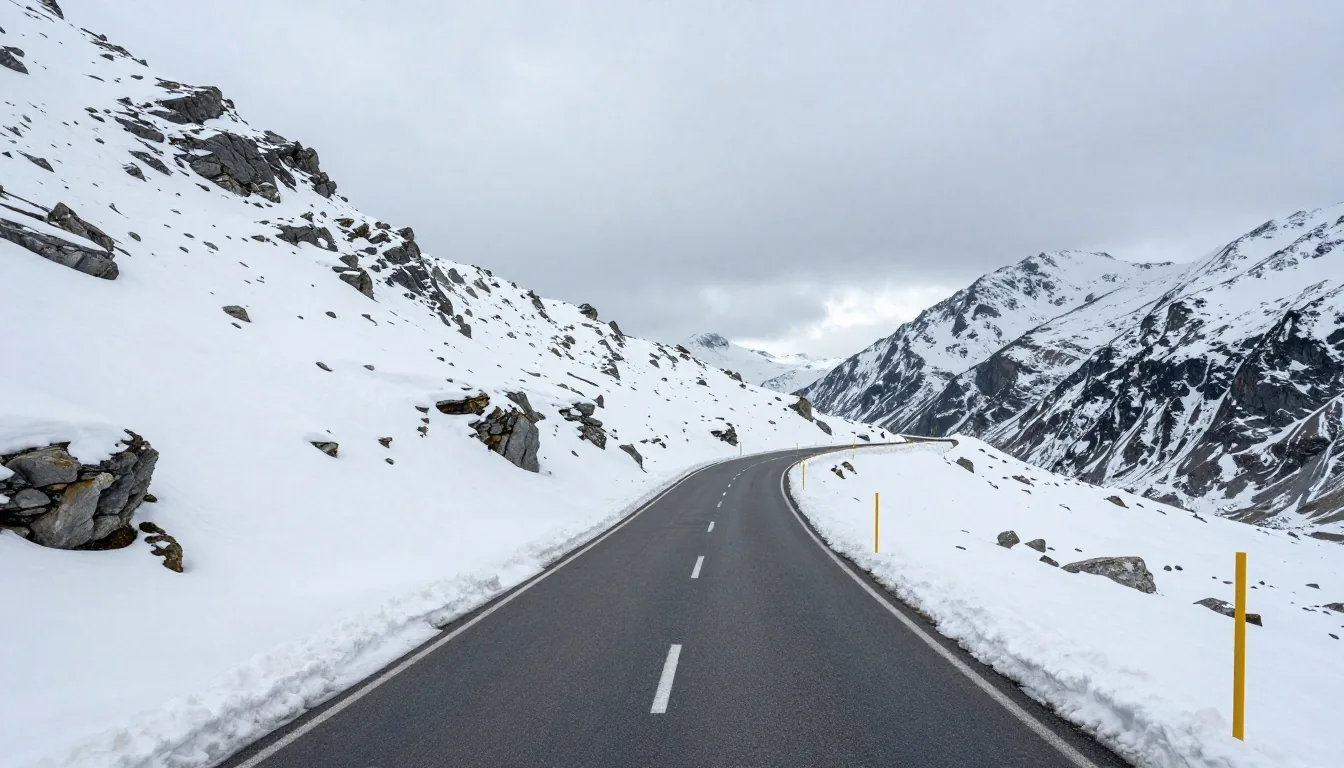
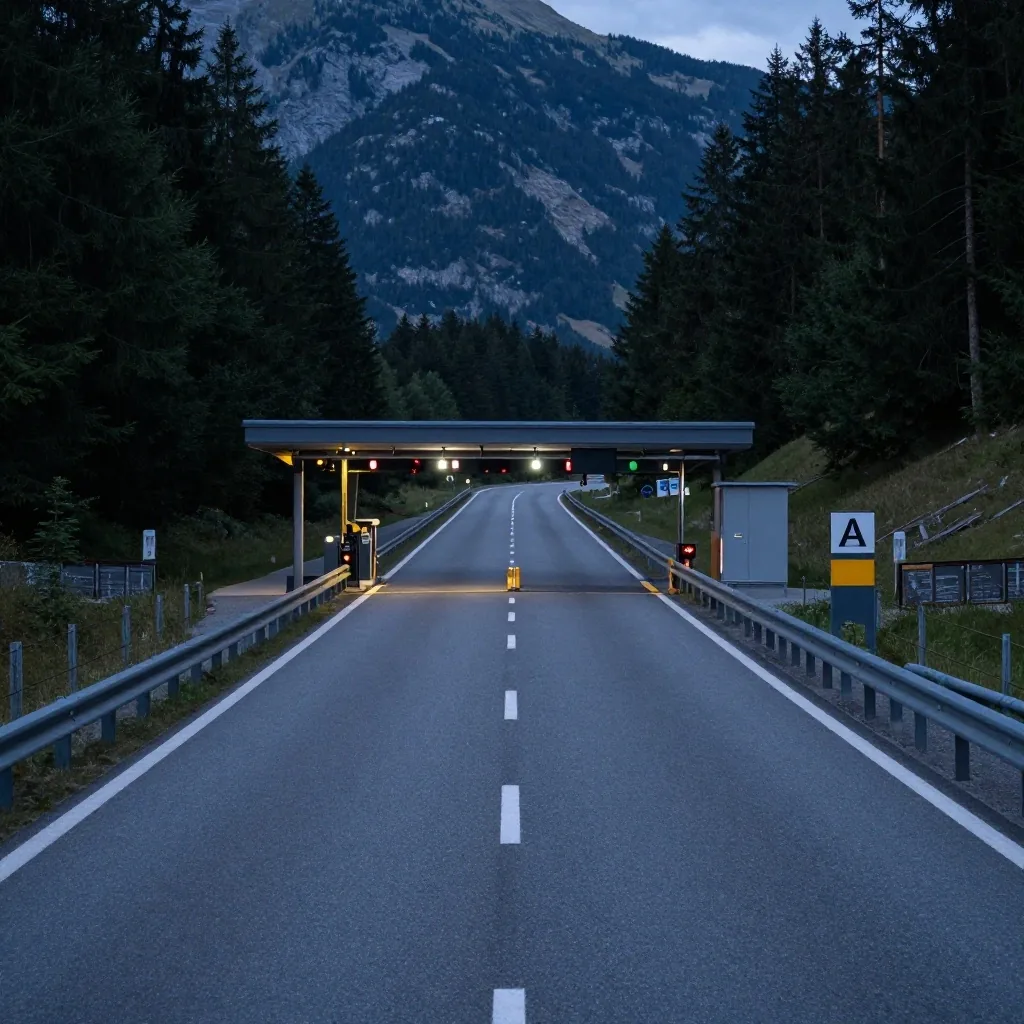
Plan your journey across the Austrian Alps.
Access comprehensive corridor profiles, mountain pass elevation profiles, and electronic toll guidelines before departing.